Announcements

New updates and improvements to Benji Pays

  1. Updates for Business Central and PDF API Endpoint

    Release Notes

    Download official invoice PDFs through the Merchant API

    Teams using the Benji Pays Merchant API can now retrieve the official invoice PDF directly from a connected accounting system. This makes it easier for AR and collections tools to attach the authoritative document to their own customer communications, without asking Benji Pays to send the email.

    Choose the right Business Central environment

    Connecting Microsoft Dynamics 365 Business Central is now more flexible. Merchants can choose from their available production and sandbox environments, with the company list automatically updating to match their selection.

    Bug Fixes

    More reliable Business Central connections

    A Business Central company can no longer be connected to multiple Benji Pays organizations. Existing owners can still reconnect safely, helping prevent duplicate synchronization, competing webhooks, and unclear data ownership.

  2. Safer and Easier Payments, Smarter Teamwork

    New Feature
    Release Notes

    Safer payments, smoother follow-through, and better shared context have arrived.

    This release gives teams clearer ways to collaborate, more control over the customer portal, and extra protection around customer payments. It also includes several fixes that improve receipt delivery, accounting accuracy, and day-to-day merchant communication.

    New Features

    Screenshot 2026-08-21 at 11.53.50 AM

    Keep customer context in one place

    Teams can now record, reply to, resolve, edit, and pin internal notes directly on a customer. Notes are built for shared collection and billing context, helping everyone stay aligned on important instructions while keeping those conversations private from customers. The experience also includes safeguards designed to prevent unsafe content and sensitive payment information from being stored in notes.

    5

    Ability to Add notes, comments and status to a customer in Benji Pays

    Sometimes you make a change, like disabling a payment profile or the customer for auto processing and you need to communicate to your team as to why. It would be great if you could add notes on a customer to say something like "I disabled this profile as there is an issue with the invoice, will re-enable once fixed". Would also be great to be able to set a status or tag a customer in a way that showed up at the top of the customer screen prominently, something like "Do not process ever enable auto pay", or "Make sure Mike sends email approval prior to processing.".

    Adam Crandall
    Shipped 🚀

    1

    Recover invoice lookups securely

    Merchants can now offer a secure recovery form when a customer's public Pay Now lookup does not find an invoice. Customers can retry with an invoice number and date, while expiring payment links, reCAPTCHA, throttling, and privacy-friendly error messages add stronger protection against card testing. Successful lookups continue to work just as they do today.

    Choose which invoice PDFs customers see

    A new customer portal setting lets merchants hide accounting-system invoice PDFs while keeping invoice balances, payment options, and separately uploaded attachments available. This gives businesses using multiple systems more control over which invoice document their customers receive.

    Bug Fixes

    Partial payment links now charge the intended amount

    Applied invoice links now carry the requested partial amount all the way through payment processing, helping protect customers from accidental overcharges and making reconciliation easier for merchants.

    More reliable receipt delivery

    Receipt preparation now waits for invoice details to be available before determining recipients. This improves delivery to invoice contacts and reduces unnecessary operational alerts without changing the payment flow.

    Accurate accounting methods for Benji Payments bank payments

    EFT, ACH, SEPA, and Benji Payments BACS transactions now consistently use the merchant's configured Bank Payments method in nightly runs and the customer portal. This keeps accounting records aligned with merchant settings and avoids incorrect classifications.

    Clearer chargeback and returned-item notifications

    Merchant and admin notifications now clearly identify both chargebacks and returned items, explain the manual accounting steps needed to reopen an invoice for collection, and point teams to the relevant support guidance.

  3. Payment Links, Smoother Refunds, Happier Workflows

    Release Notes

    Getting paid and managing refunds just got easier. This release brings secure invoice-specific payment links, Business Central credit memo refunds, smoother Sherweb onboarding, and several payment reliability improvements.

    New Features

    Create payment links tied directly to invoices

    Partners can now create secure payment links for specific invoices through the API. Customers can make full or partial payments through the familiar portal experience, and each payment is automatically applied to the correct invoice.

    Refund Business Central payments against credit memos

    Business Central merchants can now process refunds against credit memos through the standard void and refund experience. Benji safely tracks available credit to prevent duplicate or excessive refunds and provides clear guidance when manual posting is required.

    Bug Fixes

    More reliable EPG voids and refunds

    Elavon Payment Gateway (EPG) merchants can now void and refund payments with gateway-managed surcharges more reliably. Successful reversals retain the correct surcharge amounts, while unsuccessful attempts return clearer, safer error messages.

    Transferred cards now work with portal surcharging

    Customers can use token-transferred Benji Payments cards in the customer and payment portals when surcharging is enabled. We've also improved profile-creation messages so actionable errors are clearer without exposing internal details.

    Various behind-the-scenes improvements strengthen trial billing records, accounting reference lookups, release operations, and automated payment testing. These changes do not alter customer charges, but they help keep Benji running smoothly.

  4. API Payment Links, Clearer Reminders, and Better Support Tools

    New Feature
    Release Notes

    This release expands our API capabilities, improves payment-method update communications, and delivers a collection of accounting, payment, and merchant-support fixes.

    New Features

    Create flexible payment links through the API

    Merchants and partners can now create secure payment links without first creating an accounting invoice. Completed payments are sent to Payments to Apply, giving teams a simpler way to collect funds while keeping control over how and when each link is shared.

    Enhancements

    Partner platform groundwork

    We have strengthened the behind-the-scenes context carried by partner-created accounts. This lays the foundation for richer partner experiences while ensuring account creation can continue even if a connected internal system is temporarily unavailable.

    More tailored QuickBooks Desktop invoices

    QuickBooks Desktop invoice layouts now support additional customization for prepaid invoices, grouped line items, taxes, balances, and configurable contact and footer details.

    Clearer API integration guidance

    Our merchant and partner API documentation now better reflects current authentication, validation, pagination, rate-limit, and error behavior, making integrations easier to build and troubleshoot.

    Smarter payment-method update reminders

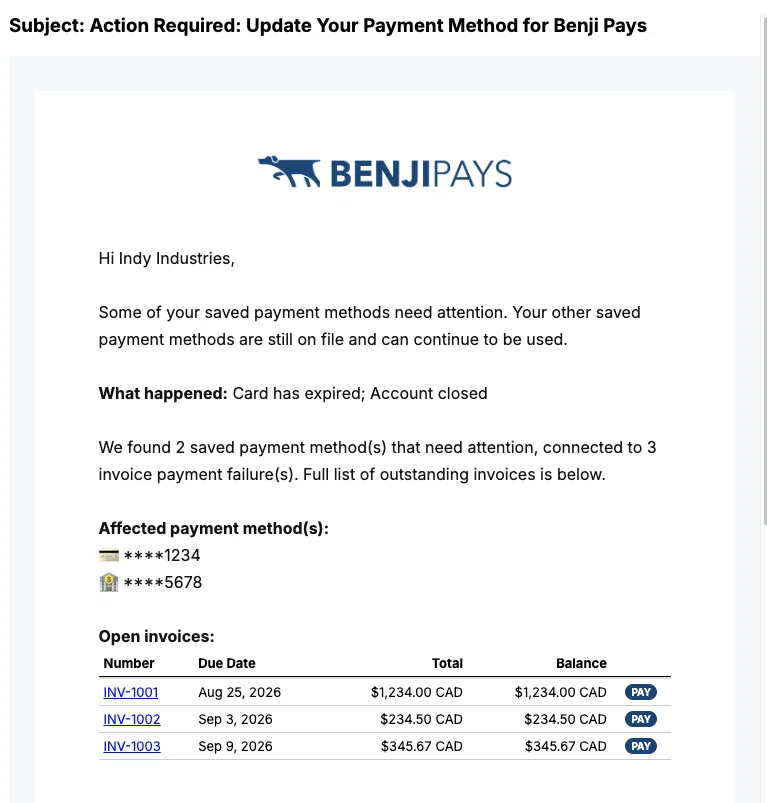
    Payment-method reminders now continue until a supported resolution actually occurs. Routine profile saves or disabling and re-enabling a method will no longer incorrectly mark an issue as resolved.

    Customers will also see clearer wording when no other payment methods are enabled for automatic payments, while Invoice Rover records provide more accurate reasons when a reminder is skipped.

    Bug Fixes

    More reliable QuickBooks fee journal entries

    Different Benji Payments fee types on the same payment now receive distinct accounting references. This prevents collisions that could interrupt report ingestion and improves the diagnostic details available to finance and support teams.

    Better decline investigation records

    Declined card tokenization attempts now point to the correct payment-call results, helping support teams trace issues more reliably without changing payment behavior.

    Correct Canadian card-rate expectations

    The standard Canadian credit-card commission is now consistently shown as 2.9%, while Amex and US rates remain unchanged.

    Plan changes are available to authorized support users again

    Support users with the appropriate permissions can once again update merchant plans, with the current plan preselected and clear feedback when the change succeeds or fails.

    Various behind-the-scenes fixes also improve platform upgrade safety, dependency security, duplicate handling, and operational diagnostics. These changes do not directly affect day-to-day workflows, but they help keep Benji Pays secure and running smoothly.

  5. Sharper APIs, Smoother Payments

    New Feature
    Announcement
    Release Notes
    quoter-benjipays

    A tidy round of updates is here, with more control over our Quoter integration, cleaner API behaviour, stronger gateway validation, and accounting fixes that make reconciliation a little less mysterious.

    This release focuses on consistency, accuracy, and reliability across the places merchants and partners use every day.

    New Features

    More control over Quoter payment links

    Merchants using Quoter can now keep surcharging enabled on a gateway while disabling Benji-managed surcharging for Quoter payment links. That gives merchants more flexibility when different payment flows need different surcharge behavior.

    Improvements & Bug Fixes

    More consistent API responses

    We’ve cleaned up response shapes across partner-focused API endpoints so pagination, identity, plan, partner, organization, and error responses behave more consistently. This gives API consumers a clearer contract to build against and makes partner support simpler for internal teams.

    More predictable API date filtering

    Date-range searches now behave more reliably for same-day searches and one-sided ranges. This helps API consumers avoid missing records when filtering transactions, emails, invoices, and other date-based lists.

    Improved Elavon Payment Gateway validation for EU merchants

    Gateway validation now routes EU and North American merchants to the correct EPG endpoint, with stronger country validation and safer handling for existing gateways. This helps reduce region-mismatch validation failures during setup.

    Cross-border card fees included in accounting

    Benji Payments accounting reports now recognize and process cross-border card fee lines through accounting flows. This helps merchants reconcile bank deposits more accurately across supported accounting integrations.

    More reliable QuickBooks Online auto-processing

    QuickBooks Online token refresh handling is now safer for high-volume merchants, reducing the chance that background auto-processing is interrupted by stale refresh tokens during busy processing runs.

  6. Safer Sign-Ins, Clearer Connections

    New Feature
    Announcement
    Release Notes

    A sturdier sign-in experience, clearer expectations, and a little less accounting cleanup? That is a tidy release bundle.

    This update gives teams more control over account security, makes the Business Central integration's beta status easier to spot, improves customer-facing communication, and smooths out Xero top-up accounting.

    New Features

    Company-wide MFA enforcement

    Companies can now require multi-factor authentication for all users. When this setting is enabled, users need to complete MFA setup before accessing the company, including after accepting an invite or switching into that company.

    29

    Add ability to enforce MFA for all users

    Although user can enable MFA, there is no option for a company Admin to enforce MFA on all users, this should be added.

    Adam Crandall
    Shipped 🚀

    4

    More natural French customer emails

    French customer-facing email wording has been polished, including payment reminders and secure customer portal calls to action. The updated wording should feel clearer and more natural for French-speaking customers receiving payment-related emails.

    Coming Soon

    Business Central BETA label

    Business Central is now labeled as a beta accounting system. Merchants will also see a confirmation step before connecting, helping teams set the right expectations while Business Central support continues to mature.

    Business Central deposit wording and support guidance

    For merchants using the Business Central beta, deposit messaging is now clearer: deposits are treated as unapplied customer payments, or payments on account, rather than Business Central prepayment invoices or finance charges. This should make it easier to explain how deposits appear, how they can be applied to invoices later, and what to watch for with voids or refunds.

    Bug Fixes

    Cleaner Xero top-up accounting

    Benji Payments top-ups for Xero merchants now post as Spend Money bank transactions instead of manual journals. That means cleaner reconciliation for top-ups and fewer accounting retries or manual cleanup steps.

    Various behind-the-scenes security and dependency updates were also included. These do not directly change merchant workflows, but they help keep the platform healthier and more secure under the hood.

  7. Smoother Payments, Cleaner Billing

    Things are getting a little smoother behind the scenes and a lot more reliable where it counts.

    This release brings better billing-address handling for stored Benji Payments cards on Payment Links, fixes for payment-method update emails and partner trial billing, clearer reporting for accelerated settlement fees, and more useful sync logs for support teams.

    New Features

    More useful QuickBooks Desktop sync logs

    QuickBooks Desktop sync logs now show the date window used during a sync, including the prior sync-back date at the start and the new sync date at completion. That gives Support and Engineering a clearer trail when investigating missing records or unexpected sync ranges, without changing merchant sync behavior.

    Bug Fixes

    Payment Method Update emails now include update links more reliably

    Payment Method Update emails now generate card-update links even when Customer Portal is disabled. Template editing also warns teams when they use portal-login links that require Customer Portal, helping prevent confusing customer emails before they go out.

    Partner free trials now line up with the usage month being billed

    Partner/API billing now checks whether the billed usage month was covered by the merchant’s free trial, instead of only looking at the day the billing job runs. This prevents trial-covered usage from being billed just because invoicing happens after the month ends.

    Behind-the-scenes release workflow improvements

    Various behind-the-scenes improvements were made to deployment and rollback workflows, including cleaner reusable pipeline pieces and traffic cutover support where configured. These updates do not directly change merchant-facing behaviour, but they help keep releases easier to maintain and operate smoothly.

  8. Cleaner Syncs, Clearer Screens, Stronger Groundwork

    api-response-shapes

    A little housekeeping, a little groundwork, and a lot more reliability.

    This release improves accounting sync reliability, restores expected reminder processing, cleans up merchant-facing UI text, and lays more foundation for future Business Central and Merchant API work in Benji Pays.

    New Features

    (Groundwork) Merchant API responses are more consistent

    Merchant API response shapes have been cleaned up across key endpoints, including customers, gateways, transactions, payment methods, settings, and related formatting. This prepares the API for a more predictable integration experience, with clearer naming and fewer endpoint-specific quirks.

    (Groundwork) Business Central invoice attachments now follow the invoice

    Business Central support now includes uploaded invoice attachments across key invoice workflows, including invoice emails, receipt emails, email reminders, customer portal invoice views, and attachment downloads. Once available, this will help supporting files travel with the invoice instead of requiring a separate manual step.

    (Groundwork) Business Central surcharge accounting is more complete

    Business Central surcharge handling now supports the journal entries needed across invoice payments, manual payments, and unallocated payment flows. This helps prepare for clearer surcharge accounting, stronger reconciliation support, and better handling after payment activity such as voids and reversals.

    (Groundwork) Payment Method Update reminders respect company-level opt-in

    Payment Method Update reminder processing now honours company-level opt-in settings, so eligible reminder jobs can be created as expected. This restores the intended path for payment method update emails instead of allowing opted-in companies to be skipped silently.

    Bug Fixes

    Accounting sync is more reliable

    Invoice and accounting sync batching has been tightened up to reduce the chance of transient or stale invoice data appearing during sync. This also gives the Benji Pays team more reliable test coverage and fewer noisy sync-related failures behind the scenes.

    Merchant-facing table labels now wait for translations

    Affected tables and buttons now wait for translations before rendering, preventing raw translation keys from appearing in place of readable labels. This improves clarity across areas like Manage Users, API Access, Profiles, Email Reminders, Chargebacks, Customer Portal Auth Logs, and Payout Reports.

    DevOps tooling improvements keep the Benji Pays team updated

    Behind the scenes, deployment notifications now give the team clearer Slack visibility when deploys start and finish, including success or failure status. That does not directly change merchant-facing screens, but it helps keep releases smoother and easier to monitor.

  9. Smoother Payments, Clearer Payouts

    Release Notes
    New Feature
    api-key-management

    A tidy round of payment polish has landed, with clearer payout details, easier payments across related invoices, ongoing work toward our API and Business Central integration, and fewer little snags getting in the way of getting paid. Nice.

    This release sharpens Benji Payments profile behaviour, improves reporting clarity, and delivers several behind-the-scenes reliability upgrades that help the whole platform feel steadier.

    New Features

    Smoother payments across related customer invoices

    Merchants can now more easily pay multiple open invoices across parent and child customer relationships, even when starting from a child invoice. The payment flow can pull together related payable invoices into one cleaner path, reducing extra clicks and making complex customer hierarchies feel a lot less twisty.

    Payout details now tell a clearer story

    Benji Payments payout drill-downs now surface more of the transaction detail behind a payout, including warning context when a capture did not complete successfully. That makes payout totals easier to understand and helps reduce confusing empty or incomplete payout views.

    (Groundwork) Smarter Customer Portal invoice visibility for Business Central

    Business Central merchants can now control which invoices appear in the Customer Portal based on invoice number prefixes. Teams can hide matching invoices, or show only matching invoices, giving merchants a cleaner way to manage what customers can see and pay. Hidden invoices are also removed from portal balance calculations, so the customer-facing portal better matches the merchant’s intended experience.

    (Groundwork) More complete Business Central invoice processing  

    Business Central invoice loading now handles multi-page invoice lists more reliably, so eligible invoices beyond the first page can be considered for auto-processing. For merchants with larger invoice volumes, that means fewer missed invoices and a sturdier sync experience.

    (Groundwork) Business Central Level III data collection

    Business Central can now collect Level III payment data, including invoice line details where available. That helps improve enhanced data coverage and supports better interchange and reconciliation outcomes for merchants using Business Central.

    (Groundwork) Auto-processing forecast API  

    A new API gives company admins and integrations a clearer preview of which invoices are expected to auto-process and why others may be skipped. This gives teams better visibility before automated payments run, instead of waiting until something needs investigation.

    (Groundwork) Stronger protection when generating API keys

    Creating a new API key now requires email OTP verification before the credential is issued. It adds one important checkpoint before organization data access is granted, helping merchants keep API access tighter and more intentional.

    (Groundwork) More useful API/MCP access

    The API now includes normalized organization profile access for the authenticated company, making it easier for AI and integration workflows to retrieve company details in a consistent format. Company admins can also list and inspect merchant-facing sent emails through the API, including filters and detail views, while internal/system email data stays out of the response.

    (Groundwork) API key expiry reminders  

    Merchants can now receive proactive email reminders before API keys expire, plus a follow-up once they have expired. That means fewer surprise integration interruptions, fewer last-minute support scrambles, and a much calmer path to keeping connected systems running.

    (Groundwork) Merchant API access and invoice responses are getting steadier

    New API access controls now line up with plan entitlement or approved overrides, and invoice API responses are moving toward a cleaner, more consistent structure. This is groundwork for broader API availability, helping future integrators work with fields that are predictable, stable, and easier to understand.

    (Groundwork) API sorting is becoming more predictable

    API sort keys now better match the response field names customers and integrators see. That makes the API easier to document, easier to use, and less surprising as the next phase of API work moves forward.

    Bug Fixes

    Debit cards are blocked earlier when a merchant does not accept them

    When a merchant has surcharging enabled and debit acceptance turned off, debit cards are now rejected during profile creation instead of being saved and failing later. That helps prevent unusable saved profiles and cuts down on repeat payment failures.

    Billing form validation no longer leaves merchants stuck

    If billing fields are invalid during Benji Payments sign-up, the page now shows validation and re-enables the form instead of leaving the merchant waiting on a spinner. This smooths out onboarding, especially when browser autofill gets a state or province value slightly wrong.

    Tax-free enhanced payment data now stays accurate

    Tax-free transactions now preserve the true zero-tax amount when enhanced payment data is included, keeping downstream payment details more accurate for invoices that do not include tax.

    Customer transaction totals now format properly

    The All Transactions table now formats fee and expected settlement footer totals correctly by currency, replacing a visible display bug with totals merchants can actually read.

    QuickBooks Desktop sync keeps moving after Benji Payments journal entries

    QuickBooks Desktop sync sessions now continue into customer and invoice sync when the previous phase ends with Benji Payments journal entries. That helps reduce the risk of skipped records and avoids extra manual sync-date cleanup.

    iPhone users can paste MFA codes again

    The MFA screen now supports iOS long-press paste on one-time codes again, making sign-in a little less fiddly for merchants and internal users on iPhone.

    Cleaner settlement estimates for Benji Payments BACS and SEPA payments

    Estimated settlement dates now use the scheduled debit date for notified payments instead of the notification date. For Benji Payments BACS in the UK market and SEPA payments, this means reports should better reflect when bank debit payments are actually expected to settle, with settlement values hidden until they’re ready to be shown.

    Clearer settlement timing for Benji Payments BACS  

    Benji Payments BACS transactions in the UK market now show the estimated settlement date while they are in Notified status, instead of leaving that field blank. Merchants and support teams get a clearer answer on when settlement is expected.

    Behind-the-scenes reliability got a tune-up

    Release, deployment, and monitoring workflows received a few operational improvements, including safer rollback support, better release tracking, and more resilient security-agent deployment handling. Nothing flashy, just the kind of platform housekeeping that keeps the lights bright and the floorboards solid.

  10. Release Notes for June 29, 2026: Card decline handling, UK/EU enhancements, and QuickBooks Desktop upgrades

    New Feature
    Release Notes

    Title: Cleaner Portals, Smarter Syncs, Happier Payment Flows

    New Features

    Payment Method Update keeps getting smarter (beta)

    Payment Method Update support now includes EPG card declines, helping Benji capture more useful decline signals across supported gateways. PMU controls were also split from general payment-event collection, so the platform can record events broadly while enabling customer-facing PMU rules and emails only for opted-in merchants.

    Bug Fixes

    Better settlement timing for Benji Payments BACS in the UK market and SEPA advance-notice payments  

    Estimated settlement dates for notified BACS and SEPA payments now anchor to the scheduled debit date instead of the notification date. Reports also avoid showing settlement values too early for notified statuses, making the numbers cleaner and less confusing.

    QuickBooks Desktop syncs recover better after deposit handling  

    QuickBooks Desktop syncs now continue properly after deposit journal entries are processed, so customer and invoice data keeps flowing and invoice balances stay up to date.

    QuickBooks Desktop sync locks clear more cleanly  

    Per-company QuickBooks Desktop sync locks now use a shorter, sync-aware expiry. If polling stops unexpectedly, stale locks can clear sooner while keeping the normal reconnect timing intact.Business Central auto-processing is more reliable  

    Behind the scenes

    Several deployment and CI improvements landed this week too, including stronger blue/green deployment handling, better production environment lookup, improved Elastic Beanstalk retry behavior, and test-suite fixes. These are mostly invisible to customers, but they help keep releases steadier and safer.

    More control over Business Central invoices in the customer portal  (groundwork for future release)

    Business Central merchants can now control which invoices customers see by invoice number prefix. Choose whether to include only matching prefixes or hide matching prefixes, and Benji will apply that logic in both the portal invoice list and balance totals. Handy for keeping the customer portal focused, tidy, and exactly as selective as it needs to be.

    Merchant API access to organization users  (groundwork for future release)

    Merchants with the right API scope can now retrieve a paginated list of users for their organization. This opens the door for cleaner admin workflows, better integrations, and easier visibility into who has access.